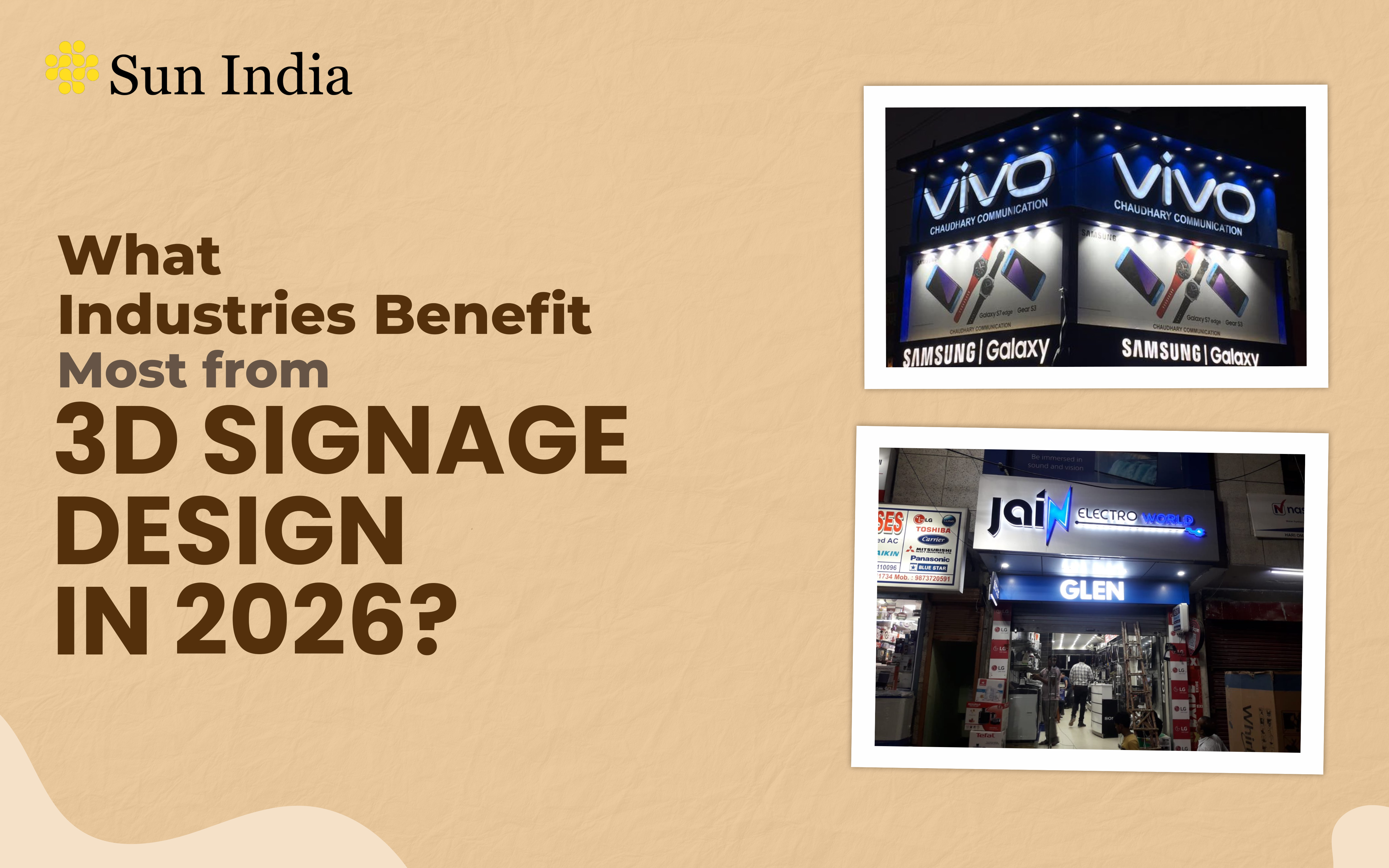
What Industries Benefit Most from 3D Signage Design in 2026?
One approach that continues to gain relevance in 2026 is 3D signage, a format that adds depth, dimension, and visibility to brand messaging. Unlike traditional flat signage, 3D Signage Design integrates materials, lighting, typography, and spatial placement to create a visual identity that stands out in crowded environments.
Businesses across India are increasingly adopting dimensional signage because it improves visibility, strengthens brand recall, and enhances the overall customer experience. Whether placed on storefronts, inside commercial buildings, or in high-traffic public locations, three-dimensional signage creates a more engaging and professional presentation.
The demand for 3D Signage Design in Delhi has grown particularly in commercial hubs where businesses operate in competitive environments and rely on strong visual branding to attract customers. Companies such as Sun India work with organizations across industries to design signage systems that communicate brand identity clearly and consistently.
However, not every sector uses signage in the same way. Some industries depend heavily on visual branding and physical visibility to guide, inform, and influence customers. This article explains which industries benefit the most from 3D signage design in 2026 and why it has become an important part of modern brand communication.
Understanding 3D Signage Design
Before exploring industry applications, it is useful to understand what 3D signage involves.
What Is 3D Signage?
3D signage refers to signage where letters, logos, or symbols are raised or dimensional rather than printed on a flat surface. These signs often use materials such as:
- Acrylic
- Metal
- Stainless steel
- Aluminum composite panels
- LED lighting components
The dimensional effect makes the sign visible from multiple angles and improves readability in both indoor and outdoor environments.
Why Businesses Use 3D Signage
Organizations invest in dimensional signage for several reasons:
- Improved visibility in crowded locations
- Stronger brand recognition
- Professional appearance for storefronts and offices
- Clear navigation in commercial buildings
- Better integration with architectural design
Because of these advantages, several industries rely heavily on 3D signage to communicate with customers and visitors.
Retail Industry
Retail remains one of the industries that benefits most from 3D Signage Design.
Why Retail Stores Use 3D Signage
Retail environments depend on foot traffic and instant recognition. Dimensional signage helps stores stand out in shopping districts and malls.
Key benefits include:
- Stronger storefront visibility in crowded commercial areas
- Brand recognition through raised logos and illuminated letters
- Directional guidance inside large retail stores
Retail signage often includes illuminated channel letters, acrylic logo signs, and backlit panels.
Impact on Customer Experience
3D signage contributes to:
- Easier store identification
- Professional brand presentation
- Improved wayfinding inside stores
For retail brands operating in metropolitan markets such as Delhi, visibility plays a significant role in attracting walk-in customers.
Hospitality and Hotels
Hotels, restaurants, and hospitality venues use dimensional signage to create memorable brand experiences.
Applications in the Hospitality Industry
Common hospitality signage applications include:
- Hotel entrance logos
- Lobby reception signage
- Restaurant name boards
- Directional signs for amenities
Dimensional signage works well in hospitality environments because it integrates with interior design and architecture.
Benefits for Hotels and Restaurants
Hospitality businesses use 3D signage to:
- Establish brand identity at entry points
- Guide guests through large properties
- Maintain consistent visual communication
In many cases, illuminated signage is used to enhance nighttime visibility and improve guest navigation.
Healthcare Facilities
Hospitals, clinics, and healthcare institutions require signage that is clear, professional, and easy to navigate.
Why Healthcare Needs Effective Signage
Healthcare environments often involve complex layouts and multiple departments. Signage helps visitors find departments, emergency units, and administrative offices.
3D signage supports this need by offering:
- Clear department identification
- Highly visible wayfinding systems
- Durable signage for long-term use
Where 3D Signage Is Used in Healthcare
Examples include:
- Hospital entrance signage
- Department names and directories
- Emergency room signage
- Laboratory and diagnostic area signs
By improving clarity and navigation, dimensional signage contributes to a more organized healthcare experience.
Corporate Offices and Commercial Buildings
Corporate environments use signage not only for visibility but also for brand representation.
Role of 3D Signage in Office Spaces
Corporate offices rely on dimensional signage to communicate professionalism and brand identity.
Common applications include:
- Reception logo walls
- Building name boards
- Conference room identifiers
- Directional signs within office campuses
These elements help establish a consistent corporate environment for employees and visitors.
Brand Identity in the Workplace
Three-dimensional signage contributes to:
- A cohesive office design
- Stronger brand presence inside buildings
- Improved navigation for visitors
Organizations working with signage providers such as Sun India often integrate signage with interior design to maintain brand consistency across all spaces.
Educational Institutions
Universities, colleges, and schools manage large campuses that require clear navigation systems.
Signage Needs in Educational Campuses
Educational institutions use signage for several purposes:
- Identifying academic buildings
- Guiding students and visitors
- Displaying department names
- Highlighting institutional branding
Benefits of Dimensional Signage for Campuses
3D signage provides:
- Long-lasting outdoor identification signs
- Clear navigation across campus areas
- Consistent institutional branding
In large campuses, signage also improves accessibility and orientation for new students and visitors.
Real Estate and Commercial Property
Real estate developers and commercial property managers rely heavily on signage to present properties and guide visitors.
Signage Applications in Real Estate
Dimensional signage is used for:
- Residential project name boards
- Commercial complex entrances
- Office tower identification
- Property directories
These signs often combine metal lettering with lighting elements to maintain visibility at night.
Influence on Property Branding
For property developers, signage supports:
- Project identity
- Location recognition
- Professional presentation to investors and visitors
In high-density urban markets such as 3D Signage Design in Delhi, property branding plays a significant role in attracting tenants and buyers.
Entertainment and Event Venues
Event venues, theaters, and entertainment centers rely on strong visual signage to create a recognizable environment.
Signage Requirements for Entertainment Spaces
These venues require signage that can:
- Capture attention from a distance
- Display event names or venue branding
- Guide visitors within large venues
3D signage often uses illuminated letters or creative materials to align with the theme of the venue.
Enhancing Visitor Experience
Dimensional signage helps visitors:
- Identify venue entrances quickly
- Navigate large entertainment complexes
- Engage with visually distinctive branding
Why 3D Signage Is Increasingly Relevant in 2026
Several trends explain the growing adoption of dimensional signage across industries.
Integration with Architecture
Modern commercial buildings often integrate signage into the architectural design rather than treating it as a separate element.
Demand for Strong Physical Branding
Despite digital marketing growth, physical spaces remain important for customer interaction. Signage helps connect digital brand identity with real-world environments.
Advances in Materials and Lighting
New materials and LED lighting technologies allow signage designers to create durable, energy-efficient signage solutions.
These developments have expanded the role of 3D Signage Design in commercial branding strategies.
FAQs
1. What is the purpose of 3D signage design?
3D signage design creates dimensional lettering or logos that improve visibility, enhance brand recognition, and guide customers in physical environments.
2. Which industries commonly use 3D signage?
Industries such as retail, hospitality, healthcare, corporate offices, education, real estate, and entertainment frequently use dimensional signage.
3. Why is 3D signage important for businesses in urban areas?
In high-traffic cities like Delhi, businesses compete for visual attention. Dimensional signage improves visibility and helps customers identify locations quickly.
4. How long does 3D signage typically last?
The lifespan depends on materials and environmental conditions. Metal and acrylic signage used outdoors can last several years with proper maintenance.
5. Can 3D signage be used indoors?
Yes. Many businesses use dimensional signage indoors for reception areas, office branding, and directional systems.
Conclusion
As businesses continue to invest in stronger brand visibility, dimensional signage has become a practical and widely adopted solution across multiple industries. Retail stores use it to attract customers, hospitals rely on it for navigation, hotels integrate it into guest experiences, and corporate offices incorporate it into workplace branding.
The growing demand for 3D Signage Design in Delhi reflects how organizations are prioritizing clear and visually distinctive communication in physical spaces. By combining materials, lighting, and architectural integration, dimensional signage helps businesses present a consistent and recognizable identity.
Organizations planning signage systems often collaborate with experienced design providers such as Sun India to ensure their signage aligns with both functional requirements and brand identity.
As commercial environments continue to evolve in 2026, industries that rely on visibility, navigation, and customer engagement will likely continue to benefit from well-designed 3D signage solutions.