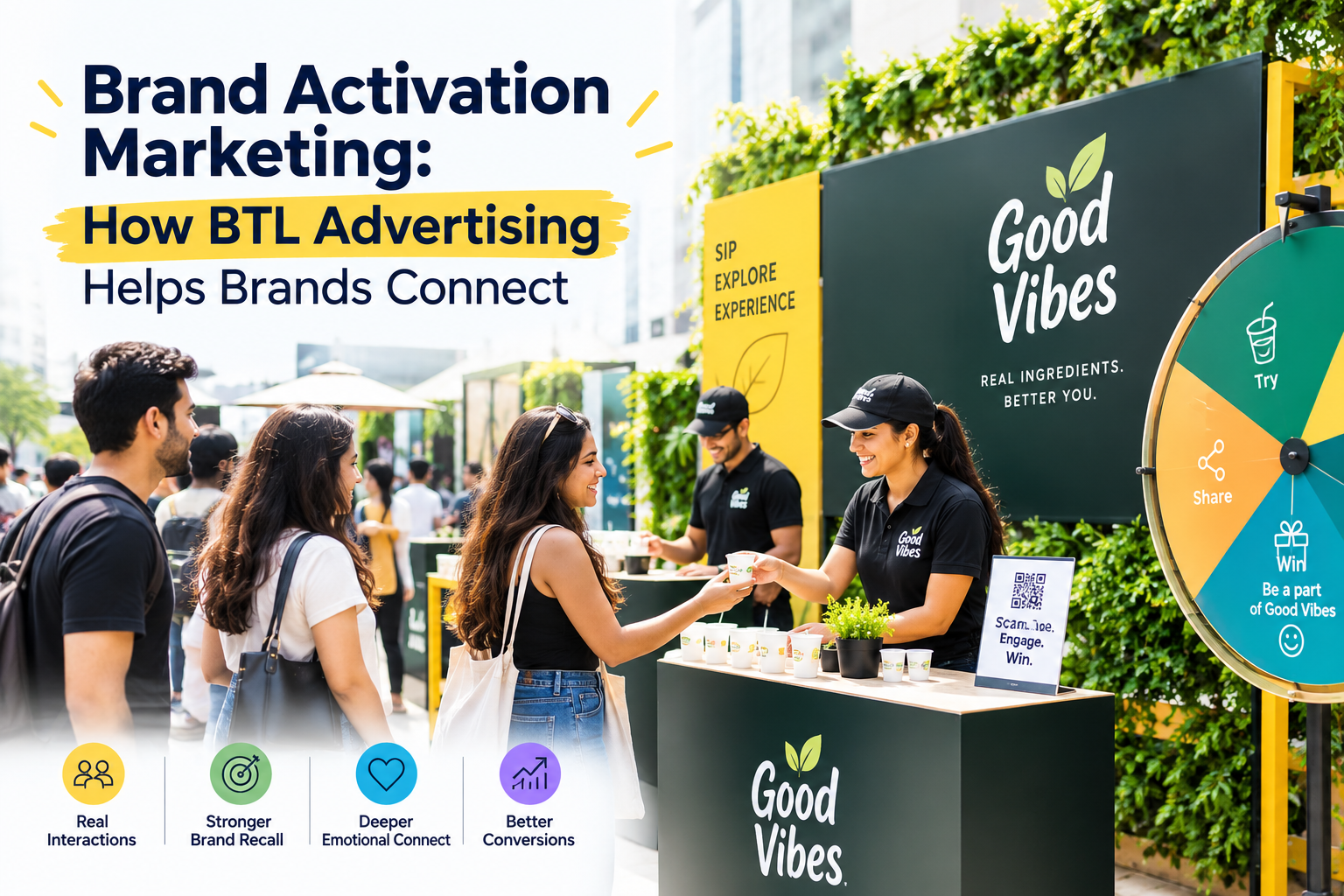
Brand Activation Marketing: How BTL Advertising Helps Brands Connect
Create real brand experiences, connect with customers, and turn everyday interactions into memorable marketing moments.
Today, customers see hundreds of advertisements every day. From social media ads and videos to banners and influencer content, brands are constantly competing for attention. In such a crowded market, simply showing an advertisement is not always enough.
This is where brand activation marketing becomes important. It focuses on creating direct and meaningful interactions between a brand and its target audience.
Whether it is a product demonstration at a mall, a corporate event, a roadshow, an exhibition, or an in-store activity, activation marketing allows customers to experience a brand in a more personal way.
For Indian businesses, this approach can be especially useful because customers often value real experiences, personal interaction, demonstrations, and recommendations before making a purchase decision.
What Is Brand Activation Marketing?
Brand activation marketing is a marketing approach designed to encourage customers to directly interact with a brand, product, or service.
Unlike traditional advertising, where the audience mainly watches or reads a message, activation marketing encourages participation.
For example, a beverage company may organise a product sampling activity at a shopping mall. A technology company may conduct a live product demonstration at an exhibition. A consumer brand may create an interactive experience at a college or corporate event.
The objective is simple: make the brand experience more memorable and encourage customers to take action.
Why Is Brand Activation Important for Modern Brands?
Brand awareness is important, but awareness alone may not always create customer engagement. People remember brands better when they experience something relevant and interesting.
A well-planned activation can help a business:
- Create direct customer interaction
- Increase product awareness
- Generate leads
- Encourage product trials
- Improve brand recall
- Support new product launches
- Build customer engagement
- Generate social media content
- Strengthen relationships with distributors and retailers
For example, instead of simply telling customers about a new product, a brand can allow them to see, touch, test, or experience it.
This creates a stronger connection between the customer and the brand.
Understanding BTL Advertising
BTL advertising, or Below-the-Line advertising, focuses on targeted marketing activities rather than mass advertising.
BTL campaigns are generally designed around specific audiences, locations, events, or customer groups.
Common BTL advertising activities include:
- Mall activations
- Roadshows
- Product sampling
- Exhibition participation
- Corporate events
- Retail branding
- In-store promotions
- Dealer and channel partner meets
- College activations
- RWA activities
- Kiosk promotions
- Product demonstrations
- Outdoor promotional activities
The key advantage of BTL advertising is its ability to create direct interaction with a defined audience.
How a BTL Agency Supports Brand Growth
A professional BTL agency helps brands plan and execute marketing activities on the ground.
The work usually starts with understanding the campaign objective. The agency then identifies the target audience, suitable locations, campaign format, communication approach, manpower requirements, branding elements, and execution timeline.
A BTL agency may manage activities such as:
- Campaign planning
- Location selection
- Creative concept development
- Stall and kiosk setup
- Branding production
- Promotional staff
- Product sampling
- Event execution
- Customer engagement
- Lead collection
- Photography and documentation
- Campaign reporting
This end-to-end approach helps brands maintain consistency during large-scale activations.
Activation Marketing for Product Launches
Launching a new product can be challenging because customers may not know what makes it different.
Activation marketing can help businesses introduce products through live demonstrations and customer experiences.
For example, a consumer electronics brand can set up a demonstration zone where visitors can try a new product. Similarly, an automobile brand can organise a roadshow or experience zone where customers can learn about product features.
Such activities can generate curiosity and encourage customers to ask questions directly.
The campaign can also collect customer feedback, which may help the brand understand audience reactions.
BTL Marketing Agency for Retail and In-Store Promotions
Retail spaces provide an excellent opportunity for direct customer engagement.
A BTL marketing agency can create attractive in-store displays, promotional counters, product demonstration areas, kiosks, and branding materials.
These activities can make products more visible at the point of purchase.
For FMCG, electronics, lifestyle, automobile, and consumer product brands, in-store activation can support product discovery and customer engagement.
A well-designed retail activation should be simple, visually clear, and easy for customers to understand.
BTL Advertising for Exhibitions and Events
Exhibitions and corporate events bring together a concentrated audience with specific interests.
This makes them useful platforms for BTL advertising.
Brands can use exhibition stalls, product displays, interactive zones, brochures, demonstrations, games, and lead-generation activities to engage visitors.
The physical experience also gives sales teams an opportunity to interact with potential customers directly.
For B2B businesses, exhibitions can be particularly useful for networking, generating business enquiries, meeting channel partners, and demonstrating products.
Role of Creativity in Activation Marketing
Creativity plays an important role in successful activation campaigns.
However, creativity does not always mean using complicated concepts. Sometimes a simple idea with strong execution can create better engagement.
A successful activation should answer three basic questions:
- What should customers experience?
- Why should they participate?
- What should they remember about the brand?
From theme development and stall design to games, demonstrations, communication, and promotional material, every element should support the campaign objective.
Measuring the Success of a BTL Campaign
Like other marketing activities, BTL campaigns should also be measured.
Depending on the campaign objective, brands can track:
- Number of visitors
- Customer interactions
- Product trials
- Leads generated
- Samples distributed
- Registrations
- Sales enquiries
- Social media engagement
- Event participation
- Customer feedback
These metrics help businesses understand whether the activation reached the intended audience and generated meaningful engagement.
Why Brands Choose Sun India for On-Ground Marketing Activities
Sun India works around brand visibility, physical experiences, and on-ground marketing requirements.
For brands planning activation campaigns, BTL advertising, exhibitions, events, retail promotions, or other customer engagement activities, having a reliable execution partner can make the campaign easier to manage.
A well-coordinated activation combines planning, creative execution, branding, manpower, and on-ground management.
The focus should always remain on creating an experience that customers can understand, remember, and connect with.
The Future of Brand Activation Marketing in India
Marketing is becoming increasingly digital, but physical customer experiences continue to have an important role.
The future is likely to involve a combination of digital and physical marketing.
For example, a brand activation can encourage visitors to scan a QR code, follow a social media page, participate in a digital contest, register for an offer, or share their experience online.
This creates a connection between BTL marketing and digital engagement.
As Indian consumers become more connected, brands can use technology, interactive experiences, data collection, and creative communication to make activation campaigns more relevant.
Conclusion
Brand activation marketing gives businesses an opportunity to move beyond traditional advertising and create real customer experiences.
From product launches and exhibitions to mall activities, retail promotions, roadshows, and corporate events, BTL advertising can help brands interact directly with their target audience.
A capable BTL agency or BTL marketing agency can bring together strategy, creativity, production, manpower, and execution to deliver a coordinated campaign.
For businesses looking to improve physical brand visibility and customer engagement, activation marketing can become an important part of an integrated marketing strategy.
Frequently Asked Questions
1. What is brand activation marketing?
Brand activation marketing is a strategy that encourages customers to directly interact with a brand, product, or service. It can include product demonstrations, sampling, exhibitions, mall activities, roadshows, events, and retail promotions. The main purpose is to create memorable customer experiences, increase engagement, improve brand awareness, and encourage customers to take a desired action.
2. What does a BTL agency do?
A BTL agency plans and manages targeted marketing activities that involve direct customer interaction. Its services may include exhibitions, mall activations, product launches, roadshows, retail branding, corporate events, sampling campaigns, and promotional activities. The agency can also handle creative planning, production, manpower, on-ground execution, coordination, and campaign reporting for brands.
3. How can BTL advertising help a brand?
BTL advertising can help brands connect directly with specific audiences through physical experiences and targeted campaigns. Activities such as product demonstrations, sampling, exhibitions, and retail promotions can improve product visibility and customer engagement. Depending on the campaign, businesses can also generate leads, collect feedback, encourage trials, and create opportunities for direct sales conversations.
4. What is the difference between BTL marketing and traditional advertising?
Traditional advertising generally communicates with a large audience through channels such as television, print, radio, or digital media. BTL marketing focuses more on targeted and direct customer interactions. It can include events, exhibitions, product demonstrations, sampling, roadshows, and retail activities. The approach allows brands to create more personalised experiences for specific customer groups.
5. Why is activation marketing useful for product launches?
Activation marketing can give customers an opportunity to experience a new product instead of only seeing an advertisement. Demonstrations, sampling, interactive displays, and launch events can create awareness and encourage people to ask questions or try the product. These activities can also provide brands with direct customer feedback and generate leads during the launch.
Contact Sun India
Looking for reliable solutions for brand activation, BTL activation, retail branding, displays, kiosks, signage, or merchandising? Connect with Sun India to discuss your branding and activation requirements.
Sun India - Events & Production Company
A-901, 9th Floor, Urbtech Trade Center, Sector-132,
Noida – 201301, Gautam Buddh Nagar,
Uttar Pradesh, India
Website: https://sunindia.in/
Email: mail@sunindia.in
Mobile No.: 9899091708, 9899548200
Get in touch with Sun India to plan customised branding solutions that help your business create a strong and engaging presence.